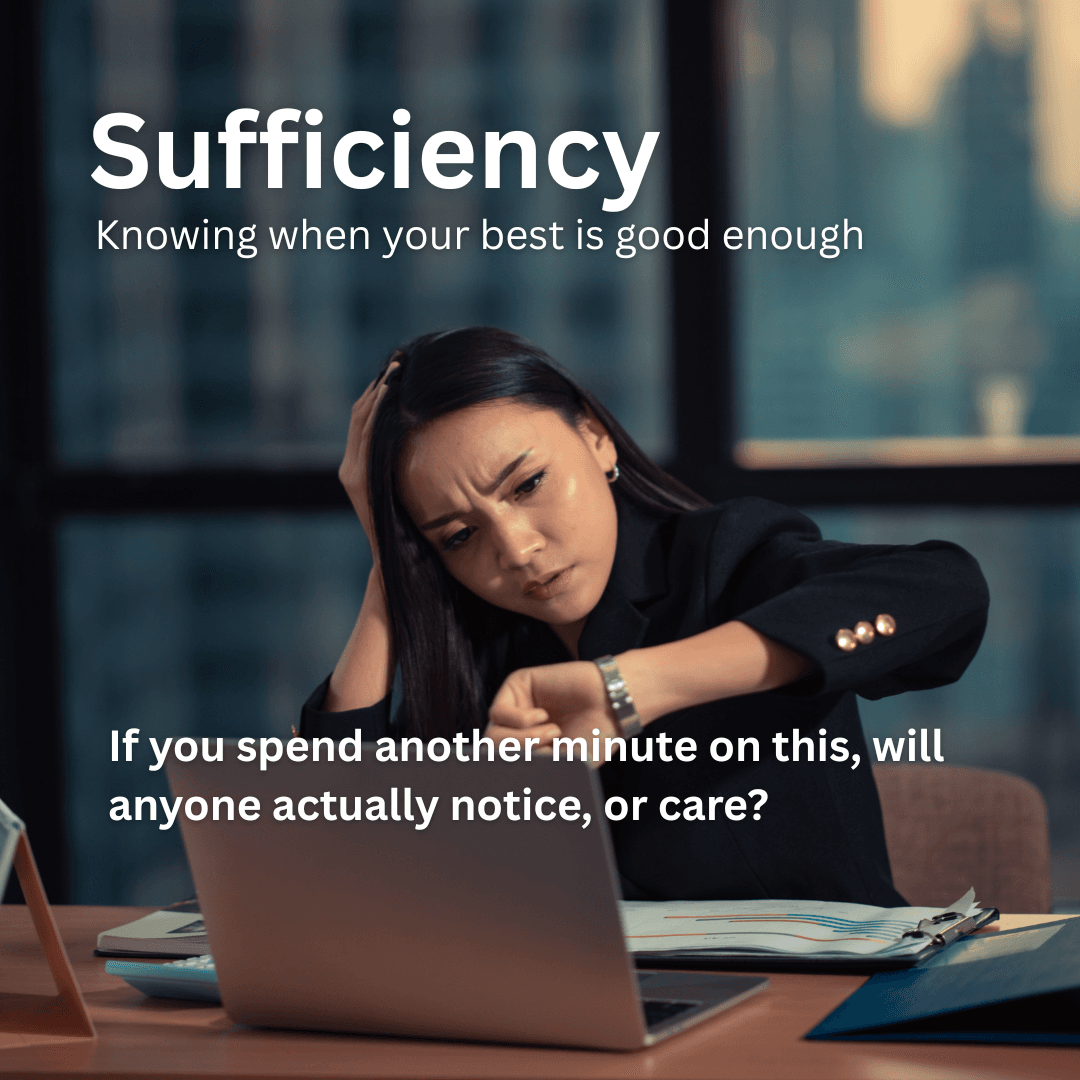
Not everything has to be perfect.
And we don’t always have to go the extra ten miles in delivering to others.
Sometimes your good is good enough.
I’m reminded of the time I spent marking and quality checking ILM assignments for our coaching & mentoring students. I think it would have been difficult to award a ‘Pass’ mark to such a subjective topic as coaching and thankfully we had guidance for each assignment which broke the criteria down into ‘sufficiency statements’. These told me what was sufficient for a ‘Pass’ and equally, what was insufficient and required a ‘Referral’. There was no ‘Merit’ and no ‘Distinction’ involved, something either met the criteria or not.
I thought this an interesting idea that might be applied to our role at work.
Sufficiency in this context is recognising when your good is good enough. It is knowing you have done the best you can with the time, energy and resources available. It is also recognising that we do not always need to strive for perfection or go the extra ten miles.
Practising sufficiency can lead to a less cluttered mind, more effective work and greater contentment.
I was reminded of this after taking a welcome mid-week break to see one of my favourite bands, Sigur Ros. It was a chance to pause and focus on people and experiences that matter. I realised I hadn’t delivered quite as much that week, yet work still moved forward, and not everything had to be squeezed into the days I had available.
Was it my most productive period? Probably not. But it was good. It was sufficient.
And of course it’s something I take into the thinking space with my valued coaching clients. I see them working really hard, long hours with lots of pressure and responsibility. Yet they still have a nagging voice, ‘have I done enough?’, or ‘how will this land?’ or ‘this isn’t quite ready yet’.
Recognising when ‘good’ is probably good enough takes practice and discipline and in mastering it, it frees you up to deliver more value, to more people.
Here are three ways to start practising sufficiency:
- Decide what good enough looks like. Before starting, be clear about what is sufficient given the time and resources available.
- Notice the point of diminishing returns. Would another hour, ten minutes or even one minute materially improve the outcome? Would anyone notice or care?
- Ask what is actually required. Do not assume everything is urgent or has to be perfect. Agree timescales and expectations in advance, and ask what a good outcome looks like.
What would you allow to be sufficient today?